

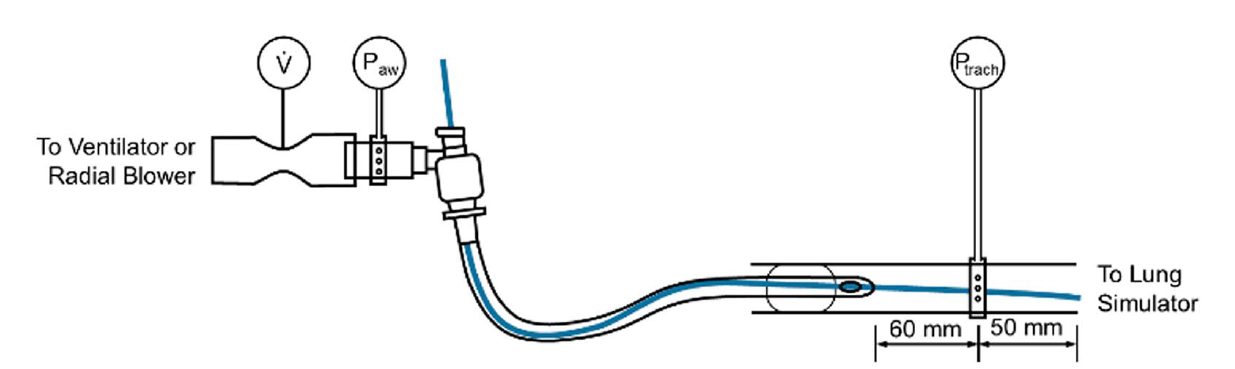
Bronchoscopy in ventilated patients severely narrows the endotracheal tube lumen and increases resistance, which can lead to hypoventilation and intrinsic PEEP build-up. These ventilation impairments depend on the geometry of the tube-bronchoscope combination, ventilator settings, and patient mechanics. Currently, no predictive method exists to quantify these impairments or guide compensatory strategies. Here, we measured pressure-flow relationships across multiple tube-bronchoscope configurations in a bench setup and derived a scaling law that describes the nonlinear, flow-dependent resistance as a function of the effective tube diameter, defined as the diameter of a circular tube with the same open cross-sectional area as the remaining lumen. Bronchoscope insertion sharply increases resistance, which scales with the inverse fifth power of the effective diameter. A browser-based simulation tool (https://fabrylab.github.io/Bronchoscopy/) accurately predicts the experimentally observed dynamic hyperinflation and intrinsic PEEP build-up. Moreover, we show that ventilation with Automatic Tube Compensation fully prevents both impairments.